So without running I've had more time to A) Pop Vicodin like they're TicTacs to get me through the nights, and B) Read more of a fascinating book: The Omnivore's Dilemma. Thus far (I'm through about half of the book), favorite part discussed just how much of our "American Diet" is corn-based. Through government subsidies and industrial innovation, the simple crop of "corn" has been broken down and re-structured into countless different substances, from carboyhydrates to proteins to fats. Take this example (Reading time is 4 minutes, and I promise it's worth it! It will give you another reason to avoid fast food, just in case you needed one):
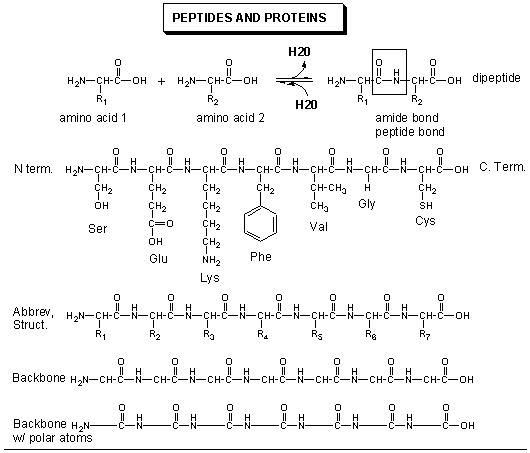
One can break down food into three main groups: Fats/Oils, Proteins, and Carbs. When looking at the structural makeup of a Fat or Oil, you'll see a LOT of "C" notations, which stands for Carbon. Much like a train is made up of indivual cars, Proteins are made up of individual pieces called Amino Acids. The centerpiece of every amino acid is...you guessed it...a Carbon atom (in the image shown here, the top row shows two Amino Acids combined to form a "dipeptide", which are then combined over and over again to form a "protein.") And then there are "CARBO-hydrates, which are combinations of Carbon, Hydrogen, and Oxygen. Obviously the center of these compounds is Carbon.
So what?
Well, Carbon is an interesting element in the fact that it has a LOT of isotopes (variations in the structure of the element). All of the isotopes are considered "Carbon," but they all are a little different and can therefore be seperated and counted...kinda like you could take all automobiles with "Ford" on them and divide them up into trucks, SUV's, compact cars, and so on. Make sense?
The ability to identify different types of Carbon is useful because fancy shmancy scientists can use a fancy shmancy machine called a "Spectrometer" to count the various number of each isotope of carbon found in a substance. Carbon that comes from Corn is almost all the same isotope, so when it appears, the scientist can infer how much of the overall carbon total in the substance being investigated originated in a corn kernel. Makes sense? (When I tried to explain this to Ellie, she simply replied, "Oh, so it's magic." In a word, yes.)
So anyway, for those STILL reading, the author of the book took some pretty standard McDonald's food items and gave them to one of the aforementioned fancy shmancy scientists, who ran them through an aformentioned fancy shmancy spectrometer to see how MUCH of the carbon in the foods came originally from corn. Remember, as mentioned above, the backbone of proteins, fats, AND carbs is Carbon. And where did the majority of the "backbone" of McDonald's food come from? Take a looksy:
Diet Coke: 100%
Milk Shake: 78%
Salad Dressing: 65%
Chicken Nuggets: 56%
Cheeseburger: 52%
French Fries: 23%
I get very strong cravings for McDonald's occasionally. But after eating it, I still feel hungry, and it never seems to be "filling," but is always "regrettable." No wonder--I'm practically eating a couple cans of corn and little else. This explains why the food doesn't really taste like much yet always gets eaten very fast. As the author puts it, "you eat more and eat more quickly, hoping somehow to catch up to the original idea of a cheeseburger or French fry as it retreats over the horizon. And so it goes, bite after bite, until you feel not satisfied exactly, but simply, regrettably, full."
I highly recommend this book to everyone--it is really easy to read and is an amazing look into why we eat what we do, and, more importantly, where it really comes from.


 I was hoping to run about 10-15 miles today, but after 9 my left achilles and calf were acting up, so I called it a day. Looking back, I'm honestly a bit surprised I made it that far. The Ice Age Trail, especially where I was running it, is a challenge at this time of the year. The leaves have fallen and covered up every inch of the trail and its rocks and roots (which make up 99% of the trail surface). Add to the fact that it rained last night, making everything a bit slippery, and walking away without a rolled ankle or a skinned elbow gave me a good dose of satisfaction.